
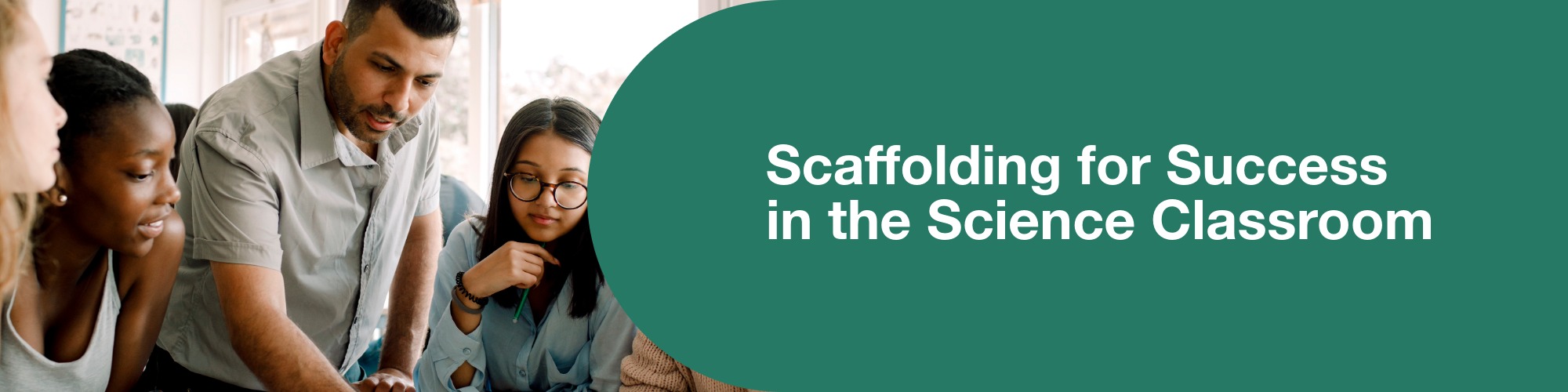
High-quality science instruction should challenge students to think deeply and grapple with complex ideas. It should also provide them with the support they need to succeed. This recorded edWebinar, led by Eric Benton and Kelly Turner, explores how to strike that balance by designing scaffolds that maintain cognitive rigor, promote productive struggle, and ensure equitable access to challenging science learning.
Drawing on decades of classroom and leadership experience, the presenters walk viewers through what truly rigorous science instruction looks like and why it matters. They unpack the difference between “more work” and “more complex thinking,” emphasizing that rigor isn’t about longer assignments or harder texts. It’s about meaningful cognitive challenge. The session breaks down key learning frameworks, including Depth of Knowledge (DOK), Bloom’s Taxonomy, and SOLO taxonomy, to help educators identify the level of thinking required in their lessons and assessments.
A central theme of the webinar is productive struggle. Benton and Turner explain how students learn best when tasks fall just beyond their current abilities but aren’t so difficult that they shut down. They connect this idea to Vygotsky’s Zone of Proximal Development and provide clear guidance on how to plan tasks that support students without lowering expectations.
The session also explores the role of phenomenon-based teaching and sensemaking in creating rigorous, student-driven science learning. Through classroom examples like having eighth graders observe “dancing rice” during a sound investigation, the presenters show how anchoring lessons in observable events builds curiosity, engagement, and authentic scientific thinking. Viewers see how students can move from surface-level knowledge to deep understanding by making predictions, building models, collecting evidence, and constructing explanations.
Throughout the session, Benton and Turner model and share practical scaffolding strategies educators can implement immediately, including:
- Sentence frames for scientific discourse and explanation
- Visual organizers aligned to NGSS practices
- Support for data analysis and evidence use
- Techniques for clarifying learning intentions and success criteria
- Approaches for gradually removing scaffolds as students gain independence
The webinar also emphasizes equity and highlights ensuring that multilingual learners, struggling readers, and students with limited prior knowledge can fully participate in rigorous science learning. Viewers learn how to adjust cognitive load while preserving grade-level thinking demands, and how to build classroom cultures that value perseverance and scientific inquiry.
Viewers leave with tools to:
- Anticipate and plan for student needs during investigations
- Design supports that enable deep thinking without diluting the challenge
- Use phenomenon and sensemaking to anchor rigorous learning
- Build student confidence, independence, and ownership of learning
This session is ideal for K–12 teachers, instructional coaches, and school leaders who are working to design science lessons that challenge, support, and position every student to succeed. By the end, teachers feel equipped to plan instruction that balances support with challenge. The webinar builds toward deeper, more meaningful learning across the science classroom.
Watch the Webinar
About the Presenters

Erik Benton is a seasoned science education professional with over 24 years of experience spanning classroom teaching, curriculum and product development, team leadership, and program redesign. His work has focused on aligning instructional materials with the Next Generation Science Standards (NGSS) and modernizing them for today’s digital landscape. He also brings deep expertise in designing and leading professional development and professional learning programs for educators.
Kelley Turner, Ed.D., is the K–12 Science Supervisor for Winchester Public Schools and Assessment Coordinator for the Virginia School Consortium for Learning. With over 25 years in science education, she has led projects to create statewide science assessment resources and promote instructionally relevant assessment practices. She has presented at state and national conferences and served as a consultant for the State Performance Assessment Learning Collaborative (SPA-LC) with the Learning Policy Institute.
In her work, Dr. Turner supports schools in designing curricula and instruction that emphasize real-world science applications, integrate AI to enhance learning, and use inclusive strategies that make science accessible for all students. Kelly focuses on embedding effective assessment practices and differentiated supports into curriculums to ensure equitable access and engagement for students, including those with disabilities and emerging multilingual learners.
Learn More
To learn more or speak to a School Specialty representative, please visit our website at https://corporate.schoolspecialty.com/brand-story/professional-development/science/.